
A little heart to heart before we begin. 🤍 Everything here is education, not medical advice. I am a Wellness Expert and a passionate researcher, not your doctor. Nothing on this page is meant to diagnose, treat, or replace personalized care. Supplements affect every body differently, and this is especially true if you are pregnant, nursing, on medication, or living with a health condition (kidney concerns included). Please talk with your own doctor before starting or changing any supplement. Foundations and personalization first, always.
Let me tell you something that took me way too long to understand.
For years I thought creatine was a guy thing. A locker room thing. Something for people chasing a deadlift PR or a bigger chest.
Then I actually looked at the research… and my jaw hit the floor.
Because creatine is not a muscle supplement that happens to help your brain.
It is a brain and body fuel that happens to help your muscles too. 🧠
And here is the part almost nobody is talking about… it may matter more for women than for men. Especially right now, in this season.
The thing nobody tells you first
Here is the fact that reframes this whole conversation.
Women naturally store far less creatine than men. Some research puts it at roughly 70 to 80 percent lower stores in our bodies. 😳
Read that again.
We are walking around with a fraction of the creatine men have. And we eat less of it too (it lives in red meat and fish, and most of us are not eating steak three times a day).
So when you hear “creatine is one of the most studied supplements on earth and it barely moves the needle for some people”… a lot of that research was done on young men who were already topped off.
We are not topped off. Most of us are running on empty.
That is not a small detail. That is the whole story. 💡
Okay but what actually IS creatine
Simple version.
Your cells run on a little energy currency. Think of it like cash your body spends to do everything… think, move, focus, recover.
Creatine helps you keep more of that cash on hand. It refills the tank faster between demands.
Your body makes a little on its own. You get a little from food. But “a little” is often not enough, especially for us.
More available creatine → more energy on tap → for your muscles AND your brain.
That is it. No magic. Just cellular energy. And your brain is one of the most energy hungry organs you have. 🔋
The benefits beyond the gym (this is where it gets good)
Your brain and mental clarity
This is the part that made me a believer.
Your brain burns through enormous amounts of energy just to think clearly. When it runs low… you get that fog. The walking into a room and forgetting why. The word that will not come. The mental molasses at 3pm.
Emerging research suggests creatine helps keep your brain’s energy stores stocked, which supports clearer thinking, faster processing, and better mental stamina.
And here is the wild part. 🤯
Researchers wanted to know what happens to a tired, depleted brain. So they studied people who were sleep deprived (hello, every woman who has ever had a toddler, a hot flash, or a 2am spiral).
They gave a single higher dose of creatine and watched the brain on a scanner.
The result… creatine partially reversed the energy dip in the brain AND improved cognitive performance and processing speed while people were exhausted.
Let that land. When your brain was running on fumes, creatine helped refill it. 🌙
That is not “gym bro” science. That is “surviving your actual life” science.
Your mood
Creatine and mood share the same root… brain energy.
When your brain is energy starved, everything feels heavier. Some research points to creatine supporting a more stable, resilient mood, and in the women-specific studies there were signals of fewer mood swings.
I am not going to oversell this. Creatine is not an antidepressant and it is not a fix for what needs real support. But a better fueled brain is a more resilient one. And resilience is everything in this season. 💛
Your energy and your afternoons
That 3pm crash is often an energy availability problem, not a “you need more coffee” problem.
Keeping your creatine stores full means your body refills its energy currency faster. More steady energy. Fewer crashes. Less white knuckling your way to dinner.
Your muscle, metabolism, and bones (still matters, just reframed)
Yes, creatine still does the muscle thing. But here is why you should care even if you never touch a barbell.
Muscle is your metabolic engine. It is your longevity insurance. It is what keeps you strong, upright, and independent for decades.
Starting in this season we naturally start losing muscle faster. Creatine, paired with any kind of strength work (even bodyweight, even resistance bands), helps you hold onto it and build it.
Stronger body → steadier metabolism → more protected bones → a future self who can still hike, lift her grandkids, and carry her own groceries. 🏔️
Let’s kill the myths (because they kept me away for years)
→ “It will make me bulky.” No. Creatine does not contain hormones and it does not magically add size. It helps your existing muscle work and recover better. Bulk comes from a very specific eating and training program most of us are nowhere near.
→ “It will make me puffy and hold water.” This is an old idea from old high dose loading protocols. Any water it pulls in goes INTO your muscle cells (that is a good thing… it is part of how it works). Most women on a steady daily dose notice nothing but feeling better.
→ “It will make my hair fall out.” This fear comes from one small old study on young male rugby players, looking at a hormone marker, not actual hair loss. It has not been cleanly shown in women at all. The internet ran with a headline. The science never backed it up.
→ “It is a steroid / it is not natural.” Creatine is made of amino acids. It is in food. Your own body produces it. It is about as natural as it gets.
→ “It will hurt my kidneys.” In healthy people, decades of research show a strong safety record at normal doses. (If you have existing kidney issues, that is a real conversation to have with your doctor first… always.)
→ “It is just for athletes.” The exact opposite may be true. If anything, the woman who is depleted, tired, and foggy has more to gain than the athlete who is already full.
And let me be honest with you, because that is how I do things here…
Not every study shows a dramatic brain benefit. Some show none. The bone research is still fuzzy. This is a promising, well tolerated tool… not a miracle. Anyone promising you the moon is selling, not teaching. 🤍
Now let’s talk about YOU specifically… perimenopause, menopause, and beyond
This is the section I wish someone had handed me years ago.
Perimenopause
This is the rollercoaster. Cycles still happening but nothing feels predictable. Brain fog, mood swings, sleep that betrays you, energy that comes and goes.
Here is why creatine fits so beautifully here.
Your fluctuating hormones affect how your body handles energy. Add our naturally lower creatine stores… and a depleted, foggy brain starts to make a lot of sense.
A recent double blind study done specifically in perimenopausal and menopausal women found that a daily creatine routine improved reaction time, raised the brain’s own creatine levels, nudged mood swings in the right direction, and even improved some markers of metabolic health.
Women. Specifically. Not young male athletes. You. ✨
Menopause
As estrogen declines, the shifts accelerate. Muscle gets harder to hold. Bones need more attention. The brain fog can deepen. Sleep gets more fragile.
Creatine becomes a foundational support here… helping your body defend its muscle, keep energy available to the brain, and pair with strength work to protect what matters.
Think of it as one steady, boring, reliable habit in a season that feels anything but steady.
Post-menopause
This is where the research actually gets strongest.
In post-menopausal women, creatine (especially at higher doses, paired with resistance training) has been shown to support lean muscle and strength. This is the muscle you are actively fighting to keep. The strength that keeps you independent.
The pattern in the research is clear… the lower doses on their own do little. The higher doses, paired with even modest strength work, are where the meaningful gains show up. More on that next. 👇
Let’s talk dosing… including the higher doses (the part most articles skip)
Here is the honest, science backed breakdown.
The daily maintenance dose. 3 to 5 grams a day. Every single day. Not just workout days. This is the “keep my tank full” dose and it is what most women should start with. Consistency beats everything here. 🗓️
The higher dose for muscle and strength (especially post-menopause). Some of the strongest research in older women used a weight based dose… roughly 0.3 grams per kilo of body weight per day, paired with strength training. For many women that lands meaningfully higher than 5 grams. This is where the real muscle and strength gains showed up in the studies… the standard small doses alone often did not move the needle.
The higher single dose for the brain. Remember that sleep deprivation study? They used a single large dose (around 0.35 grams per kilo) to acutely flood the tired brain. This is a research setting, not a daily plan… but it tells us something important. The brain CAN take up more creatine when it is depleted and demanded. Bigger stores, bigger buffer.
The takeaway. 💭
Higher does not mean reckless. It means the dose should match the goal. Brain fog and general wellbeing → steady daily. Serious muscle and strength protection → higher, weight based, with training. And a note on the tummy… higher doses are easier on your stomach when you split them across the day and take them with food and plenty of water.
(As always… if you have kidney concerns or any medical condition, loop in your doctor before going higher. This is the level 10 before level 1 rule. Foundations and personalization first.)
How I actually work it into my day (make it a ritual, not a chore)
You know I believe in rituals over rules. So here is how creatine becomes something you actually keep doing.
→ Anchor it to something you already do. I stir mine into my morning electrolyte water. It has no real taste. One glass, done, off my mind. 💧
→ Stack it with protein. Toss it in your smoothie or your post movement shake. Two birds.
→ It does not need “timing” magic. Morning, night, with food, without… consistency matters infinitely more than the clock. The best time is the time you will not forget.
→ Keep it visible. Next to the coffee. Next to your supplements. Out of sight is out of mind.
→ Give it a few weeks. Your stores fill gradually. This is a slow, steady, foundational habit… not a pre workout buzz. Trust the process. 🌱
That is it. One scoop. One glass. Every day. A tiny ritual with a big compounding payoff.
My favorite brands (the ones actually in my rotation)
You know I am picky. Better ingredients, always. Here are the three I trust and reach for.
→ Momentous. Clean, simple, seriously well made creatine monohydrate. The form that is actually studied, nothing fancy layered on top. This is my everyday go to and the one I recommend most often. 🤍
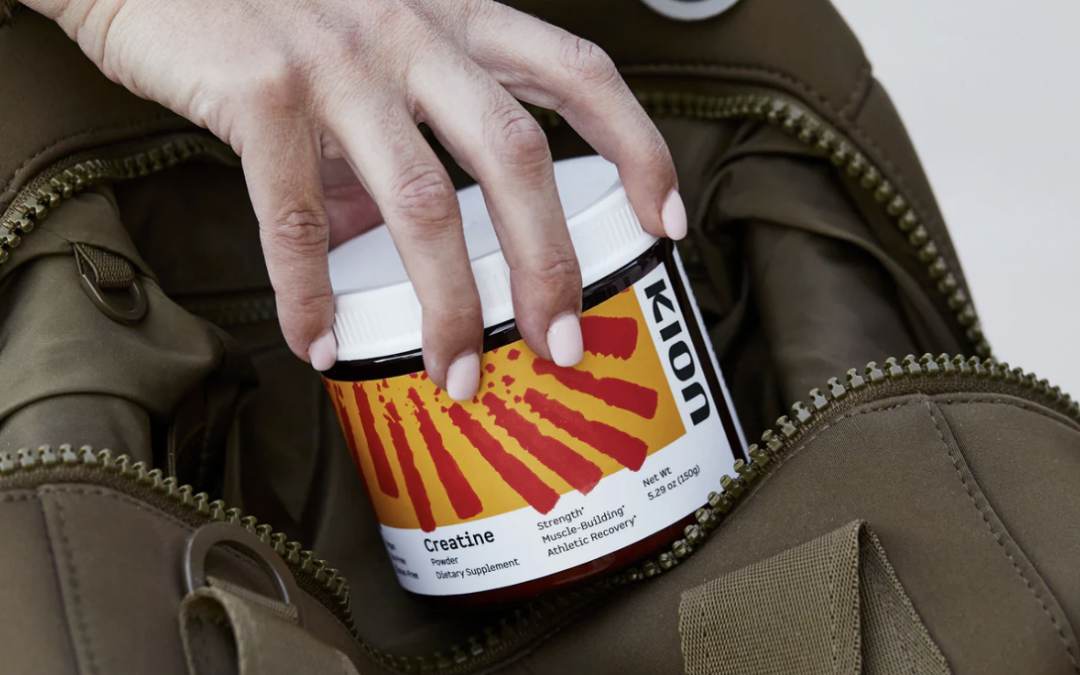
→ Kion. For the woman who wants a thoughtful, high quality monohydrate from a brand that genuinely cares about sourcing and purity. Beautifully clean.
→ Ora. My favorite when you want a plant conscious, clean label option that mixes easily and fits a more minimal, low tox lifestyle.
One rule across all of them… look for plain creatine monohydrate. Skip the flashy “special” forms with big claims and bigger price tags. The researched form is the simple one. Save your money for better food. 💛
(You can grab my exact picks and current codes on my storefront… link in my bio.)
The bottom line
Creatine is not a gym supplement you are borrowing.
It may be one of the most quietly powerful daily tools for a woman moving through perimenopause and beyond. For your brain. Your mood. Your energy. Your muscle. Your future self.
We start with less. We lose it faster. And almost no one told us.
So consider this me telling you. 🤍
One scoop. One glass. Every day.
Your future self… the strong, clear, steady one… is already thanking you.
A gentle note. This is education from my heart and my research, not medical advice. Everybody and every body is different. If you have a health condition, take medications, or have any kidney concerns, talk with your doctor before starting or increasing creatine. Foundations and personalization first, always.
Want my simple creatine starter guide plus my exact daily rituals? Comment CREATINE and I will send it straight to your DMs. 💌
📚 Research this is grounded in (for your reference)
Heads up Clarita: per your house style, study and institution names stay out of the published copy, so I kept them out of the body above. But the PubMed attribution and DOI links below are a legal requirement for using the research tool, so I am including them here. Keep this section for your own files, or trim it before publishing… your call. If you do publish it, it actually adds a nice credibility layer for the science skeptics.
Based on articles retrieved from PubMed:
- Perimenopausal & menopausal women RCT (reaction time, brain creatine, mood, lipids): Korovljev et al., 2025. DOI
- Creatine in women’s health across the lifespan (review): Smith-Ryan et al., 2025. DOI
- Creatine in women’s health, a lifespan perspective incl. lower female stores & dosing: Smith-Ryan et al., 2021. DOI
- ISSN position stand on the female athlete (dosing, post-menopausal higher doses): Sims et al., 2023. DOI
- Creatine + exercise in aging adults, benefits more consistent in women: Stares & Bains, 2020. DOI
- Creatine for lean mass, strength & bone in postmenopausal women (meta-analysis, ≥5g + resistance training): Naddafha et al., 2026. DOI
- Supplementation + exercise for musculoskeletal health in women (meta-analysis): Chen et al., 2026. DOI
- Single higher dose creatine, cognition & brain energy during sleep deprivation: Gordji-Nejad et al., 2024. DOI
- Creatine balancing brain energy asymmetry during sleep deprivation: Gordji-Nejad et al., 2025. DOI
- Creatine & strength training on mood/cognition in older women (the honest “no cognitive benefit here” trial): Alves et al., 2013. DOI
Xo,
Clarita Escalante, Founder of Claridad